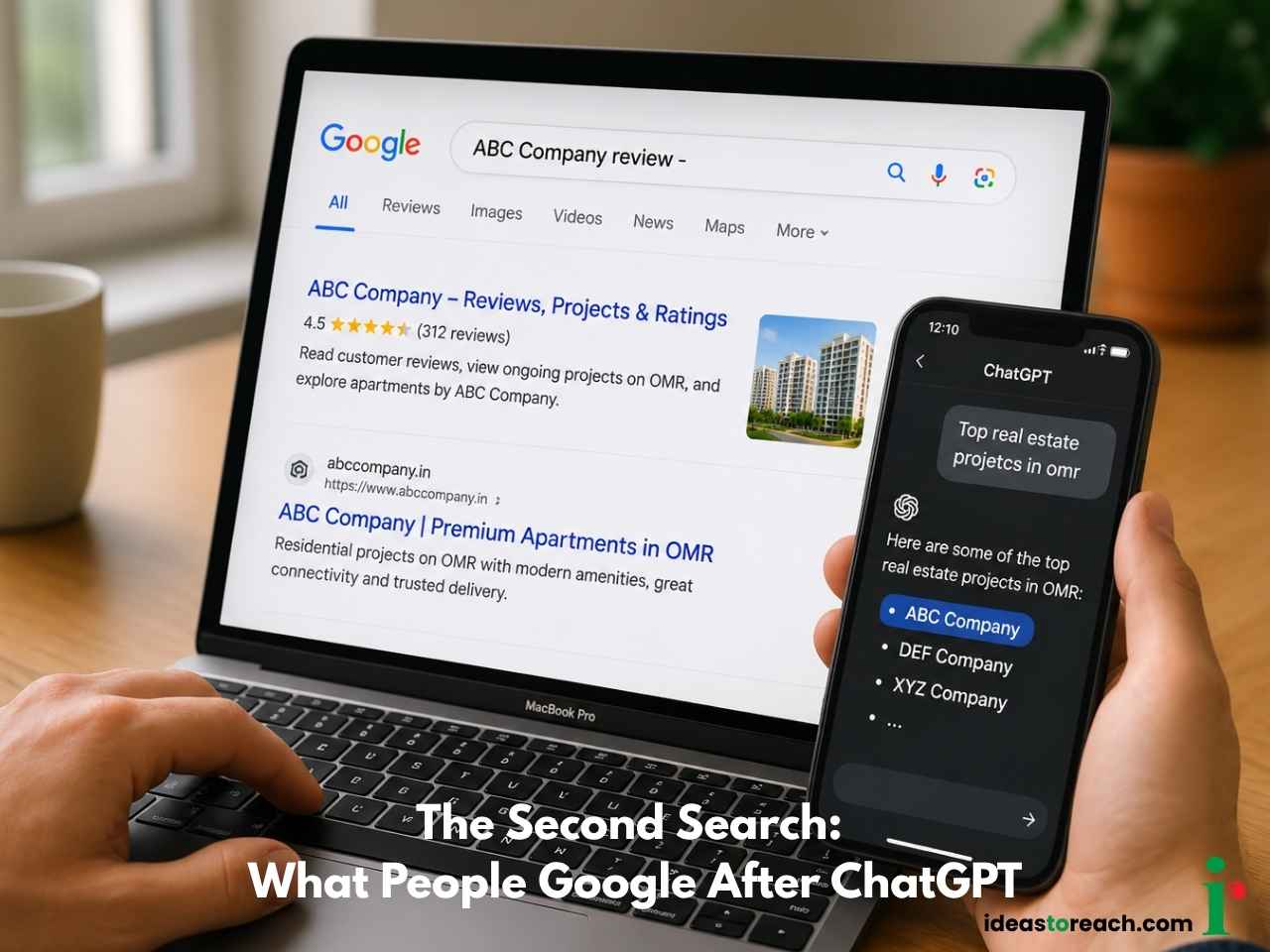
A home buyer opens ChatGPT at 11 PM and types: "Best builders on OMR for 2BHK under 80 lakhs." Within seconds, she has five names, neat bullet points and a confident summary.
She does not call any of them.
She opens a new tab, goes to Google and types the first name followed by one word: reviews.
That is the second search. And more often than most businesses realise, it is what happens during this second search that can decide which brand gets the phone call.
Think about the last time a friend recommended a restaurant.
You probably did not walk straight in. You looked it up first. You checked the photos, read a few reviews and maybe looked at the menu prices. Your friend gave you the name. Google gave you the confidence to go.
ChatGPT is that friend now. It is great at giving people a list of names. But a list is not a decision. Before people spend real money, they still want to see proof with their own eyes. So they search again.
The first search gives them options. The second search helps them pick one.
This is an important part of changing AI search behaviour. A customer may discover a business through ChatGPT, but still turn to Google to check whether that business deserves their trust. For brands, being recommended by AI is only one part of the journey.
We saw the same trust problem when we wrote about ChatGPT ads and the "new devil" problem. When people are not sure whether a guide is being honest with them, they go and check.
AI can give useful answers, compare businesses and sometimes provide sources. But an answer that sounds convincing is not always complete or up to date. That matters when someone is about to spend real money.
This is not just our opinion. A survey of chatbot users, reported by BetaNews, found that about 4 in 10 respondents checked AI-generated information using Google or other sources. Some respondents also reported encountering outdated information or unreliable references. The survey tells us that verification is a real behaviour among chatbot users. It does not mean everyone searches for a brand after using AI, but it helps explain why some customers are unwilling to rely on a single answer.
You may have seen this yourself. Ask an AI about a local shop and it might tell you about one that closed last year. One wrong answer like that, and people learn to check every answer after it.
Google works differently. It shows you many sources side by side: the website, the reviews, the map, what other people are saying. You can compare and decide for yourself. That is why people go back to it.
Also read: All That Glitters in AI Is Not Always Right, on why AI answers still need a human to check them.
By the time someone makes the second search, they already know your name. Now they are looking for proof.
Here are some common ways customers might search for a brand after discovering it through ChatGPT or another AI assistant.
| What they type | What they want to know |
| Your brand + reviews | Do real customers like you? |
| Your brand + complaints | Is there a reason to stay away? |
| Your brand + location | Are you a real business near me? |
| Your brand + price | Can I afford you? |
| Your brand vs another brand | Did the AI pick the right one? |
ChatGPT may answer some of these questions directly. But customers who want independent confirmation may still check Google, where they can examine your website, Google Business Profile, customer reviews and other publicly available information.
This is where branded search SEO becomes important. When someone searches specifically for your business, the results should make it easy to understand who you are, what you offer and whether you can be trusted.
Imagine ChatGPT recommends two real estate developers in Chennai. Both offer apartments in the same price range.
The customer Googles the first developer and finds an updated website, recent customer reviews, project details and a clear contact number.
The second developer has an outdated website, very little information and several unanswered complaints. Even if both appeared in the same AI recommendation, the customer may feel more comfortable contacting the first developer.
That is why branded search visibility is not just about appearing first for your company name. It is also about what people discover when they search for you.
Here is where a lot of businesses get confused.
Imagine a customer walks into your shop and says, "My friend told me about you." But you were not at the counter, so your staff writes it down as a walk-in. You never find out the friend sent them.
That is exactly what can happen online.
ChatGPT tells someone about you. They then search your name on Google, click your website and send an enquiry. Your reports say the lead came from Google. The AI did the introduction, but Google gets the credit.This is one reason AI-influenced customer journeys can be difficult to identify through conventional website analytics.
An ecommerce analysis covered by Search Engine Land examined how ChatGPT referral traffic compared with non-branded organic search traffic. It also raised an important attribution question: what happens when someone discovers a product through AI but later returns through Google?
In that situation, the eventual visit may appear as organic search traffic rather than a direct ChatGPT referral. Standard acquisition reports may therefore miss AI's earlier influence. This does not prove that every increase in branded Google traffic comes from ChatGPT. It simply means the customer's original discovery source may not always be visible in the final conversion report.
So how do you spot it?
Start by watching how many people search for your brand name each month. Then compare that trend with your advertising activity, direct website visits, customer enquiries and other marketing efforts.
If branded searches increase without an obvious explanation, AI recommendations could be one possible contributor. But you will need additional evidence before drawing that conclusion.
We have explained how to read website traffic sources in our guide to finding out where your website visitors really come from.
You cannot see every conversation in which ChatGPT recommends your business. But you can look for signals that help you understand how people discover and verify your brand.
You do not need an expensive new platform to begin. Google Search Console, Google Analytics 4 and a simple question on your enquiry form can provide a useful starting point.
Open Google Search Console and look at the search queries that include your business name, product names or common brand variations. Compare impressions and clicks over time. Are more people searching for your company directly? Are searches for your brand alongside words like "reviews", "price" or "location" increasing?
These changes can help you understand branded search demand, although they cannot identify ChatGPT as the source on their own.
Use GA4 to review organic search traffic and the enquiries or purchases associated with it. Then compare these results with your branded query trends in Search Console.
For example, if branded searches and organic enquiries both increase, it may be worth investigating what is driving the additional interest.
Remember that GA4 does not automatically separate branded and non-branded Google organic traffic. You will need Search Console query data or an appropriate reporting setup to make that distinction.
This is often the simplest way to collect evidence of AI-assisted discovery.
Add a question to your enquiry form: "How did you first hear about us?" Include "ChatGPT or another AI assistant" alongside Google Search, social media, referrals and other relevant options. You can also ask your sales team to record the answer during enquiries. Over time, these responses may reveal discovery patterns that website analytics cannot show.
No single metric tells the full story. But combining search trends, website enquiries and customer feedback gives you a clearer picture than looking at organic traffic alone.
Many agencies will tell you to focus only on getting mentioned by AI. Being on the AI's list does matter. But it does not guarantee that someone will visit your website or become a customer.
For customers who make a second search, what they find on Google can influence whether they contact you or move on to another business.
If they see a clear website, good reviews and honest answers, they are more likely to feel confident about contacting you. If they see a messy page, old information or unanswered complaints, they may move on to the next name on the list.
That is why AI search visibility and traditional SEO should not be treated as competing strategies. AI can introduce your business to potential customers, while a strong presence in Google Search can help those customers verify what they have been told.
That is why we keep saying that being found on Google still decides whether you are found anywhere else. It is also why we told Chennai businesses that the sky won't fall if you are missing from AI Overviews, as long as your SEO is strong.
You do not need any new tool for this. You just need an honest hour.
Open a private browser window and search your brand name with "reviews" and your city. Look at the first page. Would you trust this business?
Also check what appears when you search for your brand alongside words like "price", "complaints" and "services". Remember that results can vary by location and personalisation, even in private browsing mode.
If a bad review shows up on the first page, reply to it politely and in public.
An unanswered complaint can leave potential customers with doubts. A calm, helpful response shows that your business takes customer feedback seriously, even when something has gone wrong.
If AI calls you "a builder in OMR", your website and Google profile should say the same thing, provided that description is accurate.
Make sure your business name, location, contact details, services and operating information are consistent wherever customers find you.
The goal is not to copy whatever AI says about your business. It is to make accurate information easy for both people and search systems to find.
Price ranges, timelines and how your process works. If your website doesn't answer these, a stranger on a forum may answer them for you. Create useful pages or FAQ sections that address genuine customer concerns. Explain your pricing approach, service process, delivery timelines and any important limitations.
Clear answers can reduce uncertainty before a customer even contacts your team.
Add "ChatGPT or another AI app" as an option in your "How did you hear about us?" question.
Review those responses alongside branded search performance and website enquiries. This can help you understand whether AI-assisted discovery is becoming part of your customer journey.
To see what else is worth tracking, read how to check if your SEO is actually working.
No matter how good AI gets, people still want to see proof with their own eyes. Whether it is a home, a hospital or a college, people want to do their homework before committing. That is why the second search still matters.
And AI does not build a brand's credibility from scratch. Its recommendations draw on information available across the web, from websites and search engines to customer reviews and trusted publications. So AEO and GEO are not separate jobs. They are what strong SEO looks like today. Strong SEO is the foundation on which effective AEO and GEO are built.
So our advice is simple. Don't chase AI mentions and forget about Google. Treat every AI recommendation like a friend's referral who will look you up before they visit. Make sure they like what they find.
ChatGPT can help customers discover brands, but some will still use Google to verify recommendations before making a decision.
The second search may include your brand name alongside words like reviews, price or complaints.
AI-influenced enquiries may appear as Google organic traffic when customers return through a branded search.
Branded search visibility, customer reviews and accurate business information can help build trust after an AI recommendation.
Google Search Console, GA4 and customer feedback can help businesses investigate AI-assisted discovery, although none proves attribution on its own.
Google yourself, fix what you find, answer the awkward questions and ask customers where they heard about you.
At Ideas to Reach, we help businesses look trustworthy when customers come back to check. From search visibility to branded SEO and reputation signals, the goal is to help potential customers find the information they need to make a confident decision.
Want to know what your second search says about you? Talk to our team.
The second search is a follow-up search someone makes after discovering a brand or receiving a recommendation through an AI assistant. They may search Google for the brand name alongside words like reviews, price or complaints to verify the recommendation before making a decision.
Yes, some do. A ChatOn survey reported by BetaNews found that 39% of surveyed US chatbot users checked AI-generated information through Google or other sources, while 48% reported asking follow-up questions to test answers. These figures describe general verification behaviour, not specifically branded searches after AI recommendations.
Branded search helps customers find information about a business they already know by name. When someone discovers your company through ChatGPT, your Google search results may become an important place for checking reviews, pricing, credibility and contact details.
No. Appearing in relevant AI answers can help customers discover your business. But AI visibility works best alongside a trustworthy website, useful content, accurate business listings and a strong branded search presence.
Start by monitoring branded search impressions and clicks in Google Search Console, reviewing organic enquiries in GA4, and asking customers whether they first discovered your business through an AI assistant. These signals can help you investigate AI's influence, although they cannot establish every customer's complete journey.
Ideally, they should find your official website, accurate business details, relevant customer reviews, clear information about your products or services, and helpful responses to genuine complaints. The easier it is to verify your business, the more confident potential customers may feel about contacting you.



Please send a WhatsApp message only. Kindly do not call :
+ 91 - 99 4040 1010 | + 91 - 94 97 40 1010
Email: [email protected]