Written by : Viswanathan Ganesan 
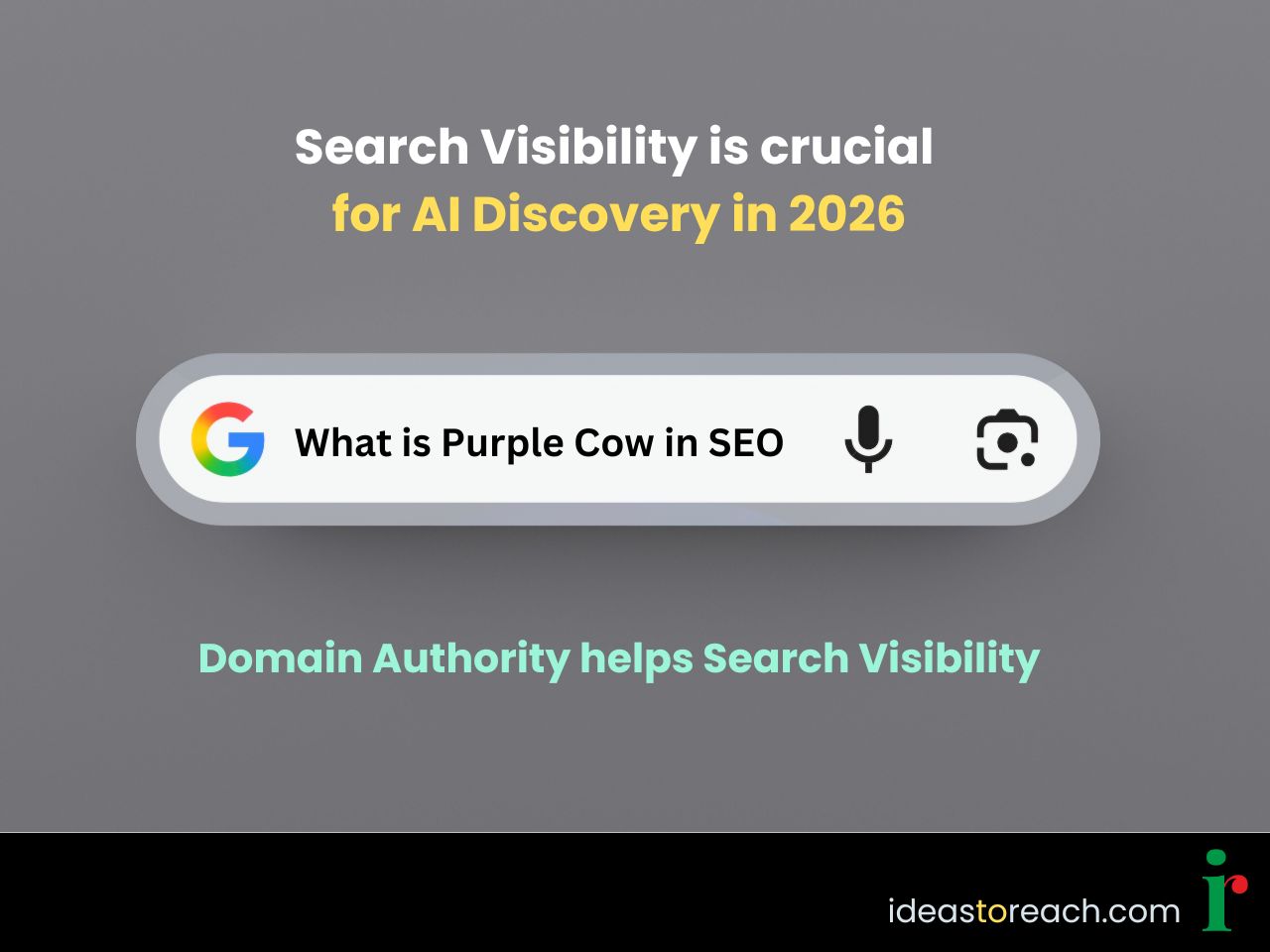
In 2026, information surfaces everywhere.
AI assistants answer questions instantly.
Summaries appear before traditional results.
Recommendations flow across devices, platforms, and interfaces.
This has led to a quiet but dangerous assumption that being visible inside AI systems is enough.
It isn’t.
If your brand is not discoverable through search, it will not be consistently discoverable anywhere else that matters.
Search is no longer just one channel. It is the foundation layer feeding every other discovery system.
Mentions inside large language model responses look impressive on the surface.
But behaviour tells a different story.
LLM citations generate almost no real engagement. In most cases, clicks from AI answers fall close to zero or hover around a fraction of a percent.
That means:
No compounding traffic
No audience growth
No sustained brand recall
Being referenced without being visited does not build businesses.
This is why Google Search results continue to outperform AI-only answers when it comes to real clicks, something explored in depth in
https://www.ideastoreach.com/
AI overviews do not float independently.
They are built on:
Indexed pages
Ranking signals
Authority evaluation
Link-based trust systems
Search is the verification engine.
If your content is not trusted by search, it does not become a reliable source for AI summaries.
This relationship is explained clearly when you examine how AI search layers are evolving, as discussed in
https://www.ideastoreach.com/
Search visibility in 2026 influences far more than rankings.
It determines:
Whether you appear in AI summaries
Whether your content feeds voice answers
Whether your pages support recommendation systems
Whether your brand becomes a reference point
Search has become the distribution engine behind visibility everywhere.
If you disappear from search, you quietly disappear from AI systems as well.
Despite interface changes, one signal remains structurally powerful.
Domain Authority.
Authority reflects how search systems evaluate trust based on:
Quality backlinks
Contextual relevance
Editorial mentions
Historical credibility
AI systems inherit these trust signals. They do not bypass them.
This is why Domain Authority now functions like a digital reputation score, a concept explored in
https://www.ideastoreach.com/
Two sites can publish equally strong content.
The one with higher authority:
Gets indexed deeper
Ranks more consistently
Appears more often in AI overviews
Feeds multiple discovery surfaces
Content explains.
Authority validates.
Without validation, even excellent content struggles to scale.
Not all backlinks shape authority equally.
In 2026, contextual backlinks outperform volume-driven link building because they signal:
Editorial trust
Topical relevance
Real-world endorsement
Links embedded naturally inside meaningful content teach search systems what you are known for.
This is exactly why contextual link strategies now directly influence AI visibility, as explained in
https://www.ideastoreach.com/
Contextual links do more than pass strength.
They define:
Your topical neighbourhood
Your expertise boundaries
Your relevance to conversations
This is essential for AI summaries, which rely on topic confidence, not keyword repetition.
There is a comforting belief that great content automatically wins.
In practice, content needs a trust carrier.
In 2026:
Content delivers insight
Authority delivers reach
Backlinks deliver validation
Remove any one of these, and visibility weakens.
This relationship is clearly visible when analysing why some content ranks effortlessly while others stagnate, a pattern discussed in
https://www.ideastoreach.com/
Blogs remain one of the strongest long-term assets online.
But blogs do not perform in isolation.
A well-written blog on an authoritative domain:
Feeds AI summaries
Builds topical maps
Strengthens internal linking ecosystems
Delivers traffic for years
This is why evergreen content plays a central role in authority-building frameworks like
https://www.ideastoreach.com/
Modern platforms handle technical basics by default.
Most websites today are:
Crawlable
Indexable
Structurally sound
In 2026, technical readiness is assumed.
The real competition happens at the trust and authority layer, not the configuration layer.
Technical SEO admits you into the race.
Authority decides who finishes ahead.
AI systems must avoid misinformation.
To do that, they rely on domains search already trusts.
That trust is built through:
Clean backlink profiles
Contextual editorial mentions
Consistent topical relevance
This explains why AI overviews repeatedly pull from authoritative sources rather than newly published but untrusted pages.
Paid traffic stops the moment budgets stop.
Authority-driven organic traffic compounds.
When Domain Authority improves and contextual backlinks strengthen, organic discovery:
Feeds AI systems
Supports brand recall
Converts better over time
This is why, in real scenarios, organic traffic increasingly outpaces paid traffic once authority crosses a threshold.
Search rankings turning into revenue is explored further in
https://www.ideastoreach.com/
Being search-first does not mean ignoring other channels.
It means understanding that search authority powers:
AI discovery
Content reuse
Multi-platform presence
Brand trust
When authority is strong, everything else works harder.
Here is the simplest way to explain discovery in 2026:
Search decides who is trusted.
Authority decides who is chosen.
AI decides how it is presented.
Reverse this order, and visibility collapses.
Interfaces will change.
AI will evolve.
Formats will multiply.
But discovery continues to follow the same logic.
Search rewards trust.
Trust is built through authority.
Authority is reinforced through contextual backlinks.
Those who invest here are not chasing trends.
They are aligning with how visibility actually works.
Being found everywhere begins with being found in search.
Being trusted everywhere begins with being trusted by search.
And in 2026, Domain Authority and contextual backlinks remain the strongest signals behind that trust, shaping not only rankings but AI visibility itself.
Everything else is built on top of that foundation.



Please send a WhatsApp message only. Kindly do not call :
+ 91 - 99 4040 1010 | + 91 - 94 97 40 1010
Email: [email protected]