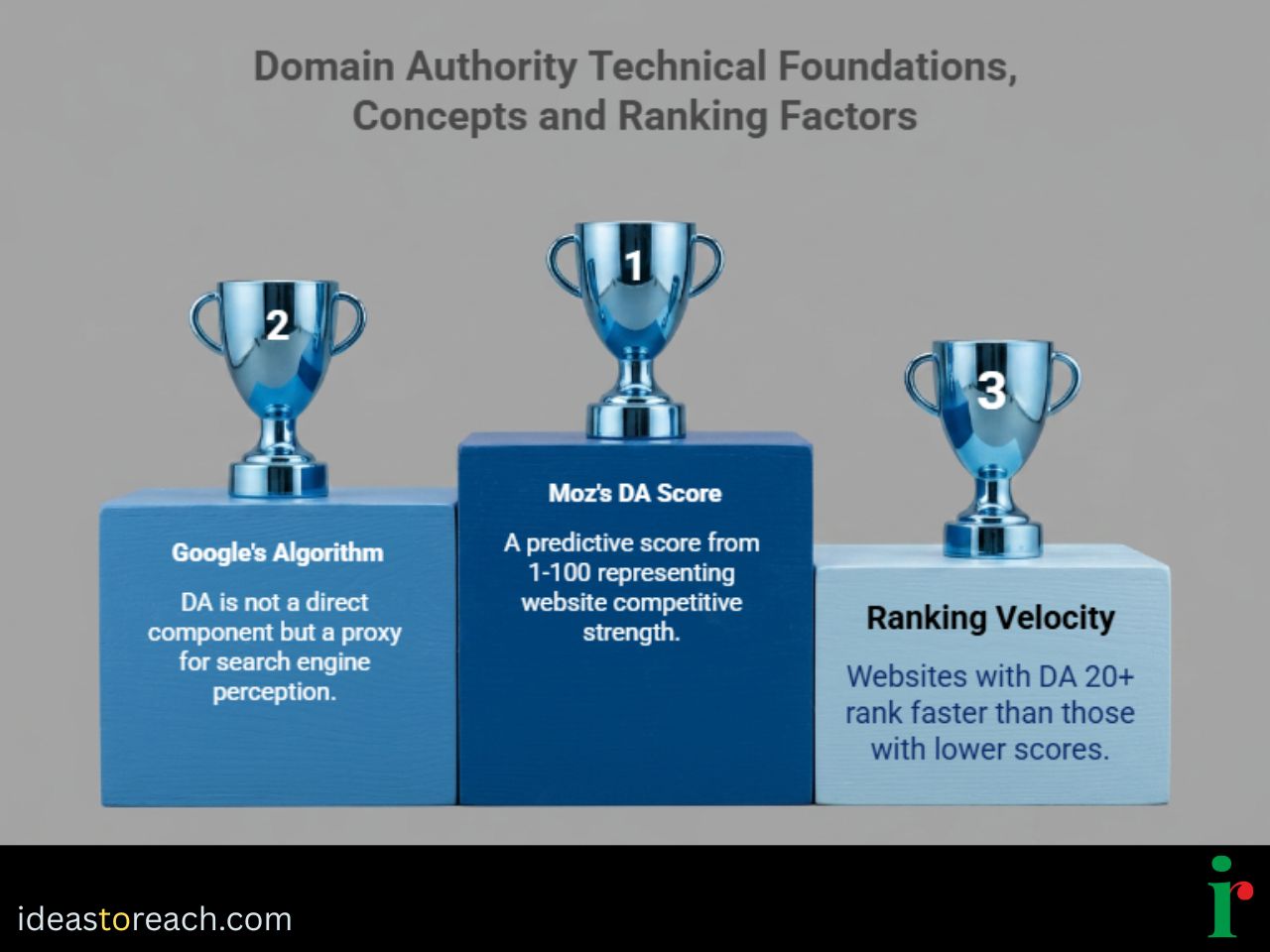
Domain Authority (DA) is a predictive search engine ranking score that provides a numerical representation of a website's competitive strength. Developed by the software company Moz, this metric is measured on a scale from one to 100. While it is not a direct component of Google's proprietary ranking algorithm, it serves as an essential proxy for how search engines perceive the merit and credibility of a domain. In professional search engine optimization practice, it is widely observed that websites reaching a score of 20 or higher demonstrate significantly faster ranking velocity than those with lower scores. This guide provides a technical and strategic overview of the metric and its role in modern digital visibility.
The technical architecture of Domain Authority is built upon the analysis of a website's backlink profile. By aggregating data points such as the number of linking root domains and the total count of individual backlinks, the metric produces a single score that predicts ranking potential.
The score is generated through a machine learning model. This model identifies an algorithm that best correlates with thousands of actual search engine result pages. Because the model relies on a vast, shifting web index, Domain Authority is a dynamic metric. It is influenced by the overall growth of the internet, meaning a site's score can change based on the performance of other websites in the index.
Domain Authority operates on a logarithmic scale. This mathematical structure means that it is far simpler for a new website to grow its score from 10 to 20 than it is for an established site to move from 80 to 90. This scaling is intentional, reflecting the increasing difficulty of outranking the most dominant domains on the web. For businesses starting their digital journey, reaching the initial milestone of DA 20 provides the first major boost in how quickly search engines index and rank new content.
It is necessary to distinguish between Domain Authority and Page Authority (PA). While the former predicts the ranking strength of an entire domain or subdomain, the latter focuses exclusively on the strength of a specific individual page. A website may have a moderate Domain Authority but possess specific pages with high Page Authority due to targeted link-building efforts or viral content. Both metrics should be used in tandem to understand a site's full SEO footprint.
While some debate exists regarding the direct impact of third-party metrics on search rankings, the practical evidence in the SEO industry suggests that Domain Authority is a reliable indicator of a site's "merit."
Practical experience over decades of search engine management reveals a clear correlation between authority scores and the speed of results. Websites with a score of 19 or below often struggle with long wait times for new pages to appear on the first page of search results. However, once a domain crosses the threshold of DA 20, search engines appear to treat the site with a higher level of trust. This "merit signal" results in faster indexing and a more aggressive positioning of new keywords. For companies looking to accelerate this process, Domain Authority Boosting Services Chennai can help reach these critical milestones more efficiently.
Domain Authority is most effective when used as a comparative tool. A score of 45 is not an absolute success; its value depends entirely on the scores of your direct competitors. If the leading websites in your niche have scores in the 30s, a DA of 45 represents a position of market dominance. Conversely, in highly competitive sectors, a score of 45 might be considered low. Businesses use these scores to set realistic expectations for their SEO roadmap that drives real results.
To use Domain Authority effectively, one must understand how it interacts with official search engine technologies and other industry metrics.
Google’s original ranking algorithm was based on PageRank. While Google no longer makes PageRank scores public, the concept remains a core part of their algorithm. Domain Authority acts as a modern substitute that allows professionals to estimate the current state of a site's "link equity" or "authority" in a manner similar to the original system.
Trust Flow is a metric from Majestic that focuses specifically on the quality of links. While Domain Authority considers both quantity and quality to predict ranking ability, Trust Flow measures the "perceived trust" of a site based on its proximity to known, high-quality "seed" sites. A healthy strategy aims for high scores in both.
Domain Rating is a similar metric provided by Ahrefs. While both serve the same general purpose, their calculations differ. Many professionals find that tracking both allows for a more balanced view of a site's standing. Understanding which is better, DA or DR, for rankings often depends on which tool’s web index is more comprehensive for your specific industry.
A common source of confusion is why a score might drop even when a site has not lost any backlinks.
Because the model is based on the entire web index, changes at the top affect everyone else. If high-authority domains like Wikipedia gain millions of new links, the "bar" for a score of 100 is raised. This can cause smaller websites to see a slight numerical decrease in their score, even if their actual link profile has improved.
There is a frequent question regarding whether Domain Authority affects local search rankings. In local SEO, factors like proximity are vital. However, a site with strong domain-level authority will almost always find it easier to rank in local "map packs" compared to a competitor with no authority. This is because search engines view the overall domain strength as a sign of a legitimate, established business.
Improving Domain Authority should be a byproduct of a high-quality SEO and digital marketing strategy.
Some services claim to "increase DA" overnight using spammy link networks. These techniques do not pass any real merit to the site. Search engines identify these patterns, and the result is often a loss of organic traffic. Authentic growth is achieved through ethical link building services in Chennai that focus on acquiring links from genuine, high-traffic websites.
Checking a website's authority score once a month is generally sufficient. Because the underlying data indexes are massive, they do not update in real-time. Monthly tracking allows you to measure SEO results effectively and adjust your strategy based on long-term growth.
To maintain and grow authority, regular technical maintenance is required. Broken internal links and slow page speeds can act as a "drag" on your score. Utilizing website and online visibility audit services ensures that your technical foundation is strong enough to support high authority.
A high DA does not guarantee high traffic. Authority is the "potential" to rank; content is the "vehicle" that captures the traffic. To succeed, one must turn SEO rankings into business revenue by aligning authority with a sound content strategy.
No score is permanent. The web is a competitive environment, and your ranking is always relative to what your competitors are doing today. Staying current with latest SEO updates and search trends is vital for maintaining a top-tier score.
In the modern digital economy, Domain Authority is a reflection of a brand's digital footprint and market influence. By focusing on EEAT and brand authority in SEO, business owners can build a domain that search engines trust. Crossing the DA 20 mark serves as a professional validation of a site's merit, enabling faster growth and more sustainable rankings. Having a high-authority website remains the most critical factor for turning search visibility into business growth.
Next page: Advanced Link Building and Domain Authority Growth Strategies