Everyone is talking about AI tools for SEO right now. And for good reason, they save time, cut costs, and when used right, they make your content significantly better.
But here's where most Indian marketers get stuck: there are too many tools, too many opinions, and not enough honest comparisons.
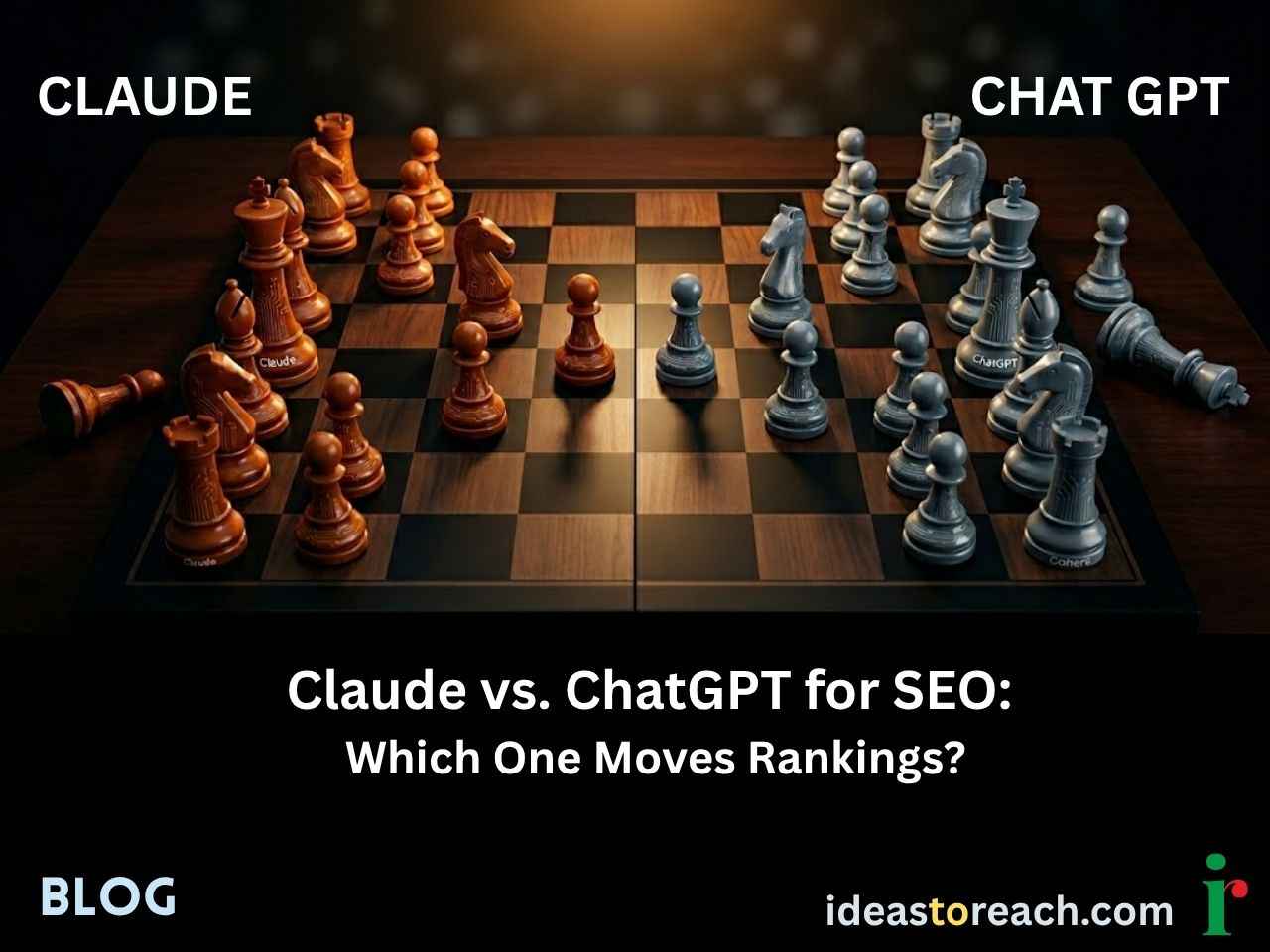
So let's settle one of the biggest questions going around right now, Claude vs. ChatGPT for SEO. Which one should you actually use? What can each tool do? And where do both of them fall short?
No fluff. No paid promotions. Just a clear, practical breakdown.
Claude is an AI assistant built by Anthropic, a US-based AI safety company. Think of it as a direct competitor to ChatGPT, but built with a different philosophy.
While ChatGPT has become the most widely recognised AI tool in the world, Claude has quietly become the preferred choice for professionals who need deeper reasoning, longer documents, and more nuanced writing. The question of whether AI can replace human SEO thinking is something worth understanding before you commit to any tool.
As of 2026, Claude is available in three versions:
Claude Haiku - fast and lightweight, good for quick tasks
Claude Sonnet - the balanced everyday model, what most people use
Claude Opus - the most powerful version, built for complex multi-step reasoning
For SEO work, Claude Sonnet handles the vast majority of tasks well. You don't need Opus unless you're dealing with very complex strategic work.
Let's get specific. Here are the SEO tasks where Claude genuinely helps, not in theory, but in day-to-day agency and in-house work.
This is where Claude stands out the most. You can upload a full crawl report, a Google Search Console CSV export, or even a 50-page competitor analysis, and Claude will read the whole thing and give you actionable insights.
Most AI tools struggle with large documents. Claude's extended context window means it can hold and reason across significantly more information in a single session, a critical advantage when you're dealing with real SEO data.
Give Claude a target keyword, your website URL, and a list of top-ranking competitors, and it will produce a structured content brief with:
Recommended heading structure (H1, H2, H3)
Key entities and topics to cover
Questions your audience is likely asking
Word count guidance based on what's already ranking
Internal linking opportunities
This alone can cut your content planning time by 60–70%.
Schema markup is one of the most underused SEO tools, mostly because writing code by hand is tedious and error-prone. Claude handles this extremely well.
Just describe your page in plain English: "This is a real estate agency's listing page for 3BHK apartments for sale in Chennai", and Claude will generate clean, accurate schema markup you can paste directly into your CMS.
Claude produces well-structured, readable content that adapts to your brand voice. If you tell it to write like a real expert talking to a non-technical audience, it does exactly that. If you ask it to match your existing blog tone, it will analyse your samples and mirror the style.
One thing to keep in mind: AI-generated content still needs a human editor. Google's systems are getting better at detecting low-effort AI content, and E-E-A-T requires real human insight that no AI can fake. Use Claude to draft and structure, then add your expertise on top.
If you run an SEO agency, you know how much time goes into writing monthly reports. Claude can take your raw numbers, traffic changes, ranking movements, conversion data, and turn them into a clear, well-written narrative for your clients. The commentary and analysis sections? Handled in minutes.
Feed Claude a seed keyword list and ask it to expand it by intent, topic cluster, or buyer journey stage. It won't pull real-time search volume data, for that, you still need tools like Ahrefs or Semrush. But once you have that data, Claude is excellent at organising and structuring it. And if you're wondering whether keywords still matter in 2026, the short answer is yes, and Claude helps you use them smarter.
Most comparisons declare one tool the winner across the board. That's not honest, and it won't help you. Here's the real picture:
| SEO Task | Claude AI | ChatGPT | Winner |
| Long document analysis | Reads full crawl reports & CSVs | Limited context window | Claude |
| Content briefs | Structured, entity-aware briefs | Good but can be generic | Claude |
| Keyword research | Works from data you provide | Works from data you provide | Tie |
| Schema markup | Clean, accurate JSON-LD | Also reliable | Tie |
| Real-time SERP data | Not available | Available via web browsing (ChatGPT Plus) | ChatGPT |
| Tone & brand voice | Adapts very well | Adapts well | Claude (slight edge) |
| Client report writing | Excellent narrative flow | Good | Claude |
| Technical SEO reasoning | Strong, nuanced answers | Can be too generic | Claude |
| Image generation for SEO assets | Not available natively | Available via DALL·E | ChatGPT |
| Plugin / GPT ecosystem | Growing integrations | Wider plugin library | ChatGPT |
| Pricing (India) | Claude Pro ~$20/month | ChatGPT Plus ~$20/month | Tie |
Bottom line: For deep SEO workflow tasks, document analysis, content briefs, and report writing, Claude has a meaningful edge. ChatGPT wins when you need real-time SERP data, image generation, or a wider plugin ecosystem. For an SEO team on a budget, the honest answer is: use both, for what each does best.
Claude cannot tell you what's ranking on Google right now, what keywords are trending this week, or what your competitors just published. For that, you still need tools like Google Search Console, Ahrefs, Semrush, or Google Trends. Claude works with the data you bring to it, it doesn't pull live data on its own.
Claude can't log into your Search Console or Analytics account. You have to export data and bring it into the conversation manually. This adds a step, but it's a manageable one.
This is the biggest misconception going around. Claude is a tool that amplifies a skilled SEO's output, it's not a replacement for knowing what you're doing. If you ask bad questions, you'll get bad answers. The quality of your inputs determines the quality of your outputs entirely.
88% of marketers are now using AI daily, but only 26% report generating measurable business value from it. The gap isn't the tool. It's how the tool is being used. If you want to know what other mistakes are quietly costing your rankings, read our blog on SEO mistakes to avoid.
Here's a repeatable process you can use for every blog post or landing page you create:
Check your Google data first.
Go into Google Search Console and find pages that are getting impressions but not getting clicked. These are your biggest quick wins.
Let Claude spot the opportunities.
Paste that data into Claude and ask it: "Which of these pages can I improve to get more clicks?" It will tell you exactly where to focus.
Plan your content with Claude. Once you've picked a keyword or topic, ask Claude to build a content plan, what headings to use, what questions to answer, what to cover.
Write with Claude, but make it yours.
Use Claude to get a first draft done fast. Then go through it and add your own experience, opinions, and real examples. That's what makes it rank.
Let Claude handle the technical bits.
Ask it to write your page title, meta description, and schema markup. Copy and paste into your website.
Publish, watch, and repeat.
Check Google Search Console a few weeks later to see how it's performing, then do the same thing again for the next page.
That six-step loop, done consistently, produces compounding SEO results. Claude makes steps 2 through 5 significantly faster without removing the human judgement that Google still rewards.
Here are 3 prompts you can use in Claude today. They cover the highest-leverage tasks in any SEO workflow.
Here is my Google Search Console data for the last 3 months [paste CSV or table]. Identify all pages where impressions are above 200 but click-through rate is below 2%. For each page, suggest one specific change to the title tag or meta description that could improve CTR. Format as a table.
Write a client-facing monthly SEO report narrative based on this data: [paste your metrics]. Organic traffic: [X] vs [Y] last month. Top ranking improvements: [list]. Key observations from GSC: [paste]. Write in plain English a non-technical client can understand. Keep it under 400 words. Be honest about what worked and what needs more time.
Generate valid JSON-LD schema markup for the following page: [describe your page in plain English, e.g. "A listing page for 2BHK apartments for rent in Anna Nagar, Chennai."]. Use the most appropriate schema type and include all relevant properties.
Is Claude better than ChatGPT for content writing?
For long-form SEO content, Claude generally produces more structured and nuanced output. For quick tasks or when you need real-time web data, ChatGPT has the edge. Most serious SEO teams use both.
Can Claude replace an SEO agency?
No. Claude is a tool, not a strategist. It speeds up execution but it cannot replace keyword research, technical audits, link building, or the experience needed to read data and make the right calls.
Is AI-generated content good for SEO?
It can be, if a human edits it, adds genuine expertise, and ensures it actually helps the reader. Google doesn't penalise AI content. It penalises thin, unhelpful content. The distinction matters. For more on this, read our piece on whether your content fills or kills your rankings.
Here's the honest truth, the Claude vs. ChatGPT debate is a distraction for most SEO teams. Both tools are good. Both have gaps. The question was never which AI is better. The question is whether you're using any of them with enough strategic clarity to actually move rankings.
So if you're sitting on the fence about bringing AI into your SEO workflow, the time to start is now. Not because AI is a trend worth chasing, but because the teams that have been doing this for the last 12 months are already compounding their advantage. Every month you wait, that gap gets a little harder to close.
The best SEO teams in 2026 aren't the ones with the biggest budgets or the most tools. They're the ones who figured out how to think clearly and execute fast. At Ideas to Reach, that's exactly how we operate, and the results speak for themselves.



Please send a WhatsApp message only. Kindly do not call :
+ 91 - 99 4040 1010 | + 91 - 94 97 40 1010
Email: [email protected]