Google AI Mode SEO marks a significant evolution in how search rankings are evaluated and delivered. Instead of relying primarily on keyword frequency, Google now uses advanced machine learning algorithms and AI-powered search technologies to understand the true intent behind user queries better. This allows the search engine to connect related entities and context, providing results that are far more relevant and helpful to users. By interpreting complex relationships between concepts and measuring real-world usefulness, Google AI Mode brings a smarter, more intuitive search experience.
This transformative approach closely integrates insights from Google Search Console AI and the latest 2025 Google Maps ranking factors. Together, these tools form a unified ranking ecosystem where local SEO, user behavior signals, and entity-based SEO all work in harmony. For businesses and marketers, understanding this new AI-driven system is essential to optimise effectively and maintain visibility in today’s increasingly sophisticated Google search landscape.
Google AI Mode goes beyond traditional blue links by using advanced AI to analyze context, pinpoint search intent, and model complex relationships between entities and user queries. This AI-driven approach enhances Google’s ability to serve up results that match not only keywords but also the real-world usefulness and authority of content.
For SEO practitioners, Google AI Mode means focusing on:
The depth of topical authority and semantic relationships, rather than isolated keywords
User behavior signals such as click-through rate and dwell time, extracted from Google Search Console data for AI SEO
Contextual signals like local relevance, proximity, and review quality from Google Maps ranking factors 2025
Effectively, this AI-fueled ecosystem prioritizes E-E-A-T signals (Expertise, Experience, Authoritativeness, and Trustworthiness) alongside deep structural markers such as structured data and knowledge graph integration, making ranking a more nuanced and dynamic process.
Google Search Console remains an indispensable SEO tool, but its role has expanded with AI Mode. The Search Console now provides critical AI insights that help website owners understand not only raw performance metrics but also user engagement and content quality at scales relevant to AI algorithms.
Specifically, Search Console data influences Google AI Mode SEO by:
Offering detailed reports on query interpretation and user engagement metrics
Highlighting structured data health and integration with Google’s Knowledge Graph to improve entity clarity
Enabling ongoing optimization based on AI summarisation of content performance and user satisfaction
Providing key feedback loops for refining topical relevance and E-E-A-T compliance in content
Using insights from Search Console, businesses can tune their content strategies and technical SEO to align with evolving AI ranking signals, thereby improving overall search ecosystem visibility.
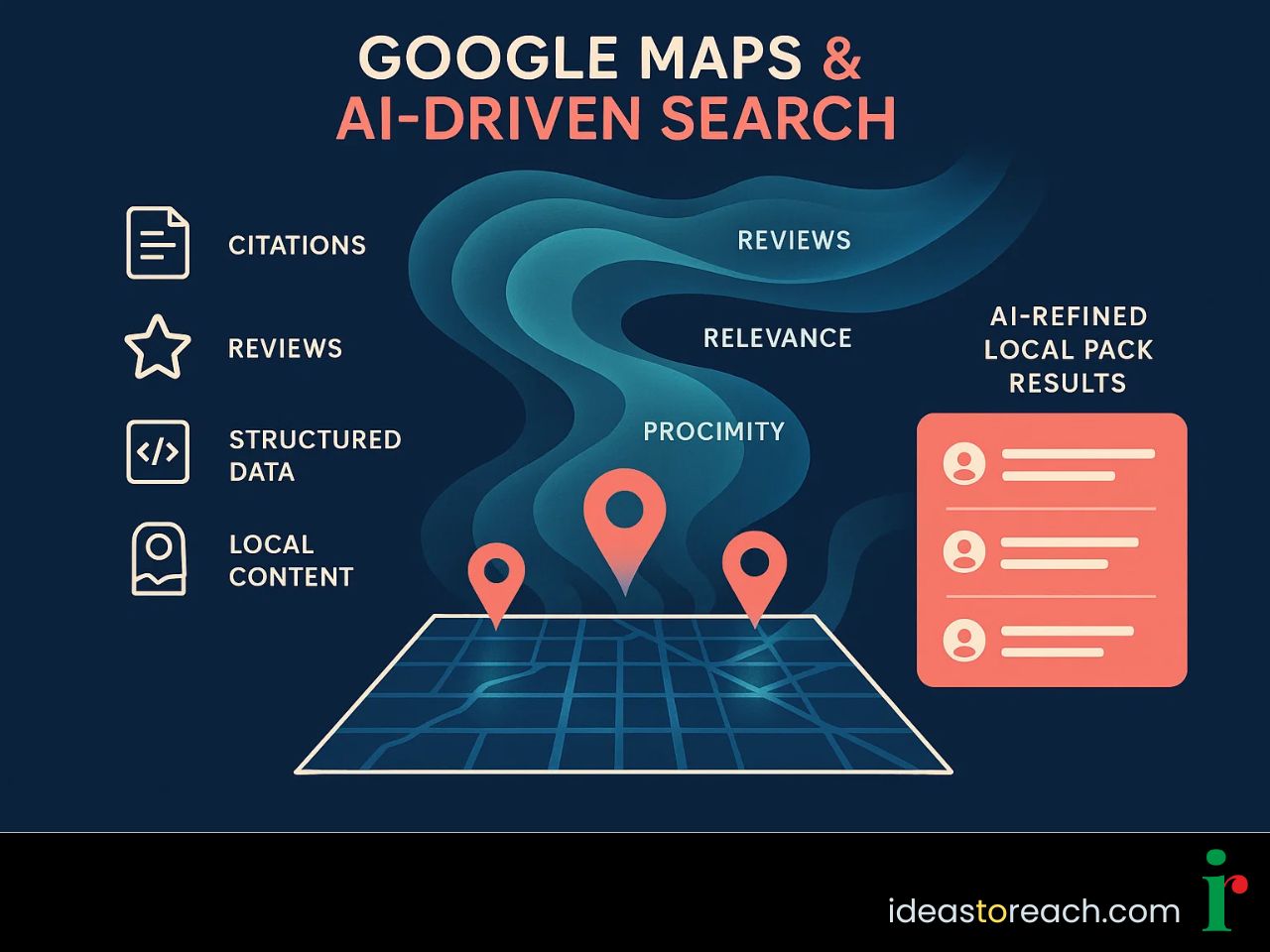
Google Maps ranking factors in 2025 play a pivotal role in the AI search ecosystem, especially for local SEO. Google AI Mode blends Maps data with AI algorithms to fine-tune local pack rankings based on proximity, user reviews, local relevance, and behavioural signals.
This interconnectedness means that:
Businesses with strong maps and local SEO presence gain higher visibility in AI-powered local searches
Consistent citations, review management, and local content improve trust & authority, boosting local search rankings
Structured data related to location, services, and reviews is crucial for AI interpretation
Google local SEO updates in India reflect these priorities, emphasizing hyper-local signals and mobile optimization for regional audiences
Indian businesses, in particular, must adapt their strategies to these local SEO nuances, leveraging Google Maps accurately and complementing this with content that serves local search intent effectively.
Preparing Indian websites for Google AI Mode SEO involves a multifaceted approach addressing topical authority, structured data, local relevance, and consistent performance monitoring.
Key optimisation strategies include:
Developing content clusters around clear entities, helping Google’s AI understand contextual relationships
Implementing schema markup and rich snippets, as outlined in our blog on structured data in AI search, to enhance Knowledge Graph presence
Strengthening Google Maps signals and completing profiles to meet local ranking criteria
Leveraging the local SEO audit checklist to address on-site and off-site local SEO factors
Monitoring Search Console regularly for AI SEO insights and adapting content according to user behavior and engagement trends
Our experience shows that Indian websites, which integrate these steps position themselves advantageously as Google’s AI ecosystem evolves in 2025 and beyond.
The impact of AI Mode on SEO is profound when compared to conventional search. Traditional SEO emphasized backlinks, exact-match keywords, and primarily static ranking factors. Meanwhile, AI Mode:
Uses dynamic machine learning algorithms that adjust ranking signals based on real-time user feedback and content performance
Employs advanced query interpretation and AI summarisation to improve snippet accuracy and search result relevance
Weighs E-E-A-T and trust & authority more heavily, rewarding content with demonstrated expertise and helpfulness
Integrates user behavior data seamlessly with local relevance factors, especially leveraging Google Maps insights for local pack rankings
The implications? Marketers need to shift from a narrow keyword focus to a more holistic strategy combining long-tail keyword strategy for SEO, user experience optimisation, and entity-driven content development.
Google AI Mode is an advanced search experience where Google uses artificial intelligence to understand intent, connect entities, and deliver more contextual results beyond traditional blue links.
Yes. Google Search Console provides engagement and performance signals that help Google’s AI systems understand content quality, relevance, and user satisfaction over time.
Google AI connects Maps data with search intent, local relevance, reviews, and proximity signals to determine which businesses appear in local and AI-generated search experiences.
Indian websites should focus on topical authority, structured data, clear entity coverage, strong local signals, and consistent Search Console performance to stay visible in AI-powered search.
At Ideas To Reach, we understand that adapting to Google’s AI search update explained requires more than basic tweaks. It calls for strategic, data-driven SEO that balances technical precision with content excellence and local relevance.
We help clients implement cutting-edge techniques such as:
Applying our strategic SEO review process powered by AI insights
Following a blue ocean SEO strategy to tap unexplored keyword markets and reduce competition
Conducting thorough technical SEO audits with Lighthouse 13 to ensure fast, crawlable, and well-structured sites
Crafting authoritative content that meets E-E-A-T and content quality signals
Employing structured data extensively to win in AI search environments
By integrating these best practices, businesses win competitive advantages in Google’s AI Mode SEO ecosystem and achieve sustainable growth.
Are you ready to future-proof your SEO with AI-driven insights and proven strategies? Contact Ideas To Reach today, and let’s start accelerating your organic presence.



Please send a WhatsApp message only. Kindly do not call :
+ 91 - 99 4040 1010 | + 91 - 94 97 40 1010
Email: [email protected]