Written by : Viswanathan Ganesan 
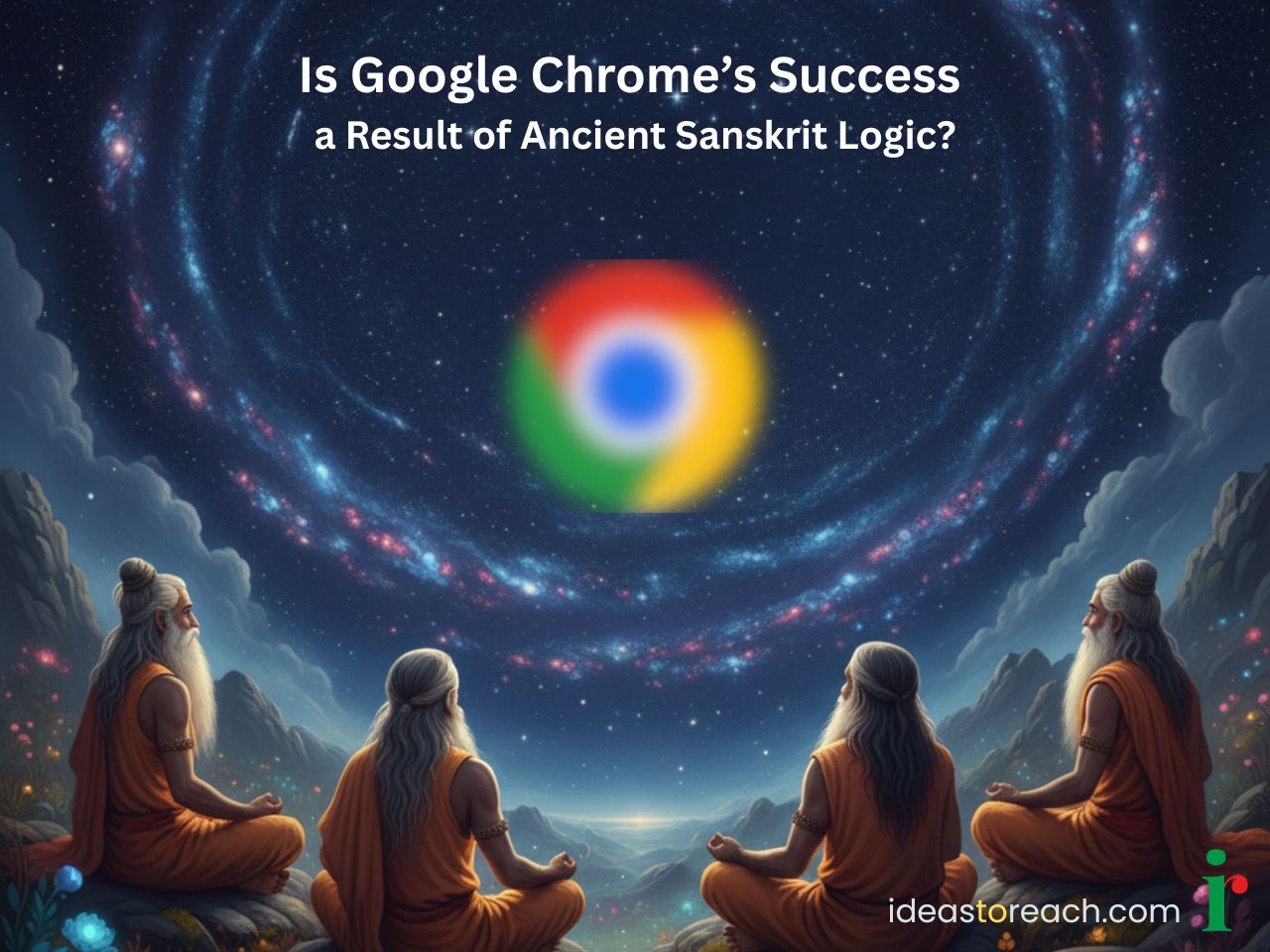
There is a high likelihood that Google’s unprecedented dominance stems from the fact that it built its house on a foundation of ancient Sanskrit logic. Specifically, the resonance of the Krom (क्रोम्) mantra and the structural framework of Desa-Kala-Patra. These are not just linguistic tools but are deeply rooted in Hindu practices and the spiritual science of the Vedas. Because only Hindus use Sanskrit in this sacred way, it is important to give credit to the Hindu Rishis who perfected these codes.
Let’s look at the sound itself. In the science of Mantra Shastra, a core part of Hindu worship and meditation, sounds are functional tools, not symbols. The Krom Beeja is a vibration designed to penetrate, command, and still the environment.
'Ka' (क): The spark of manifestation and the beginning of action.
'Ra' (र): The fire of Agni, representing speed and the light of knowledge.
'M' (म्): The nasal resonance that seals the action into the physical world.
When you say "Chrome," you are phonetically executing a sound that, for thousands of years, has been identified by Hindu Rishis as the frequency of "Forceful Entry" and "Obstacle Removal." In my experience, the likelihood that this phonetic resonance contributed to Chrome’s "stickiness" in the human psyche is something we cannot ignore. More than a name, it’s a command rooted in Hindu spiritual technology and the Sanskrit language.
This is where the "Cause and Effect" becomes undeniable. In my opinion, the search engine Chrome seems to be operating on the Vedic law of Desa-Kala-Patra, a principle that guides every Hindu ritual and decision.
For a Siddha or a Rishi, no truth is absolute. It is always relative to:
Desa (Location): The space the subject occupies.
Kala (Time): The specific moment in the cycle of time.
Patra (The Subject/Device): The specific individual’s intent and capacity.
In the context of modern technology, Patra takes on a deeper meaning. While it traditionally refers to a "vessel" or the "character" of a person in both Sanskrit and Tamil (Pathiram), it also signifies the container or device through which knowledge is received. Whether you are using a mobile, a tablet, or a laptop, the device itself is the Patra.
Google succeeded because its algorithm evolved to match this exactly. If you search for "help," Google doesn't give you a dictionary definition. It looks at your Desa (are you near a hospital?), your Kala (is it 2 AM at your location?) and your Patra (are you on a mobile device needing an immediate call button or on a desktop looking for a long article?).
By aligning with these three ancient pillars of Sanskrit and Hinduism, Google created a "Digital Rishi", a system that understands context better than most technologies we interact with.
As a marketer, I watch Google’s "Core Updates" closely. I’ve realized these aren't mere technical patches released from time to time. They are a form of Punah-Pratishta, the periodic Hindu ritual of purification and re-consecration of a power source.
Because Kala (Time) is always moving, a static algorithm becomes "dead" energy. Google’s periodic updates are its way of ensuring the system stays in harmony with the current era. It is a digital ritual that refreshes the "Krom" energy of the browser, ensuring it remains the dominant force in an ever-changing landscape.
To be clear, I am not suggesting that Sundar Pichai or the early Google engineers sat in a room and planned this out of a Sanskrit textbook.
However, as a professional who looks for the "why" behind the "what," I believe there is a genuine likelihood that when a collective of brilliant minds aims for "Universal Truth," they subconsciously move toward the guidelines already laid down by the Hindu Rishis.
In my view, the success goes beyond marketing and may be connected to an ancient Sanskrit code that Google unknowingly revived from the heart of Hindu tradition.
Is Google Chrome's name based on Sanskrit? Officially, the name comes from the "chrome" of a car or the UI of a browser. However, phonetically and energetically, it perfectly matches the Sanskrit "Krom" Beeja mantra (Also known as Beej Mantra). Whether this was intentional or a subconscious alignment with universal frequencies identified by Hindu sages is the real question.
Is there any link or connection between Google and Sanskrit codes? Sanskrit is a highly structured language. While Google uses modern programming, the logic of its search results mirrors the conditional logic of Desa, Kala, and Patra found in ancient Hindu texts. This makes the search engine act like a digital version of Sanskrit logic.
What is the secret of Google Chrome's success? Beyond speed, its secret lies in context. By using the logic of Desa, Kala, and Patra, it provides answers that are relevant to your location, your time, and your specific device. It acts as a "Digital Rishi" that understands your immediate reality.
Why is Hinduism relevant to this blog? Sanskrit is the sacred language of Hinduism. The concepts of Mantra Shastra and the framework of Desa, Kala, and Patra are foundational Hindu practices. Crediting these origins is important because these codes for understanding reality were perfected by Hindu Rishis long before modern technology.
Does Patra only refer to a person's character? No. In Sanskrit and Tamil (Pathiram), it means a vessel. In our digital age, your mobile phone or laptop is the vessel or "Patra" that contains and delivers the information Google provides. This is why search results change depending on your specific device.
How does Google use the logic of the Hindu Rishis? By using the pillars of Desa (Location), Kala (Time), and Patra (Device), Google ensures that search results are not static. It follows the Hindu principle that truth and action must always be relevant to the specific context of the moment and the recipient.
Is Google's algorithm a form of Hindu ritual? In a way, yes. The periodic Core Updates are effectively a digital Punah-Pratishta. Just as Hindu temples are periodically re-energized to maintain their power, Google purifies its algorithm to ensure it stays in sync with the current Kala (Time).



Please send a WhatsApp message only. Kindly do not call :
+ 91 - 99 4040 1010 | + 91 - 94 97 40 1010
Email: [email protected]