When businesses invest in SEO, they usually track three things:
Domain Authority, rankings, and traffic.
Very quickly, a common question comes up:
“Which one should improve first?”
Before answering that, it helps to understand where your website currently stands.
Domain Authority plays a quiet but powerful role in how easily rankings improve and how consistently traffic grows. Knowing your current authority level gives important context to everything discussed in this article.
Check Your Domain Authority for Free
It takes a few seconds and helps you read the rest of this blog with clarity.
The confusion often starts when Domain Authority, rankings, and traffic are assumed to move in a straight line.
They don’t.
They are connected, but they play different roles in how SEO actually delivers results.
Think of your website as a business presence online.
Rankings decide whether people can find you
Traffic shows whether people respond when they do
Domain Authority influences how much trust search systems place in your website overall
All three matter.
But they don’t show progress in the same way or at the same time.
When SEO work begins, the earliest visible signal is usually rankings.
This often looks like:
Your website starting to appear for more search terms
Pages moving from very low positions into mid-level positions
An increase in impressions before clicks increase
This stage tells us that search engines are beginning to understand what your website is relevant for.
At the same time, while rankings are being worked on visibly, effective SEO strategies also begin strengthening domain-level trust quietly in the background.
At this stage, traffic may still be low.
That’s completely normal.
Traffic increases only when:
rankings reach strong, visible positions
the search matches what users are actually looking for
the page answers that need clearly
Not every ranking leads to traffic.
Only the right rankings do.
That’s why early SEO traffic often appears selective rather than sudden.
It reflects intent, not just visibility.
It’s also important to understand that traffic growth becomes smoother when the website itself is gaining trust at a broader level.
This background trust-building supports rankings and makes traffic growth more consistent.
If you want to know more about how rankings translate into real outcomes, this guide on how SEO rankings turn into business revenue explains the connection clearly:
Domain Authority is often misunderstood because it works in the background.
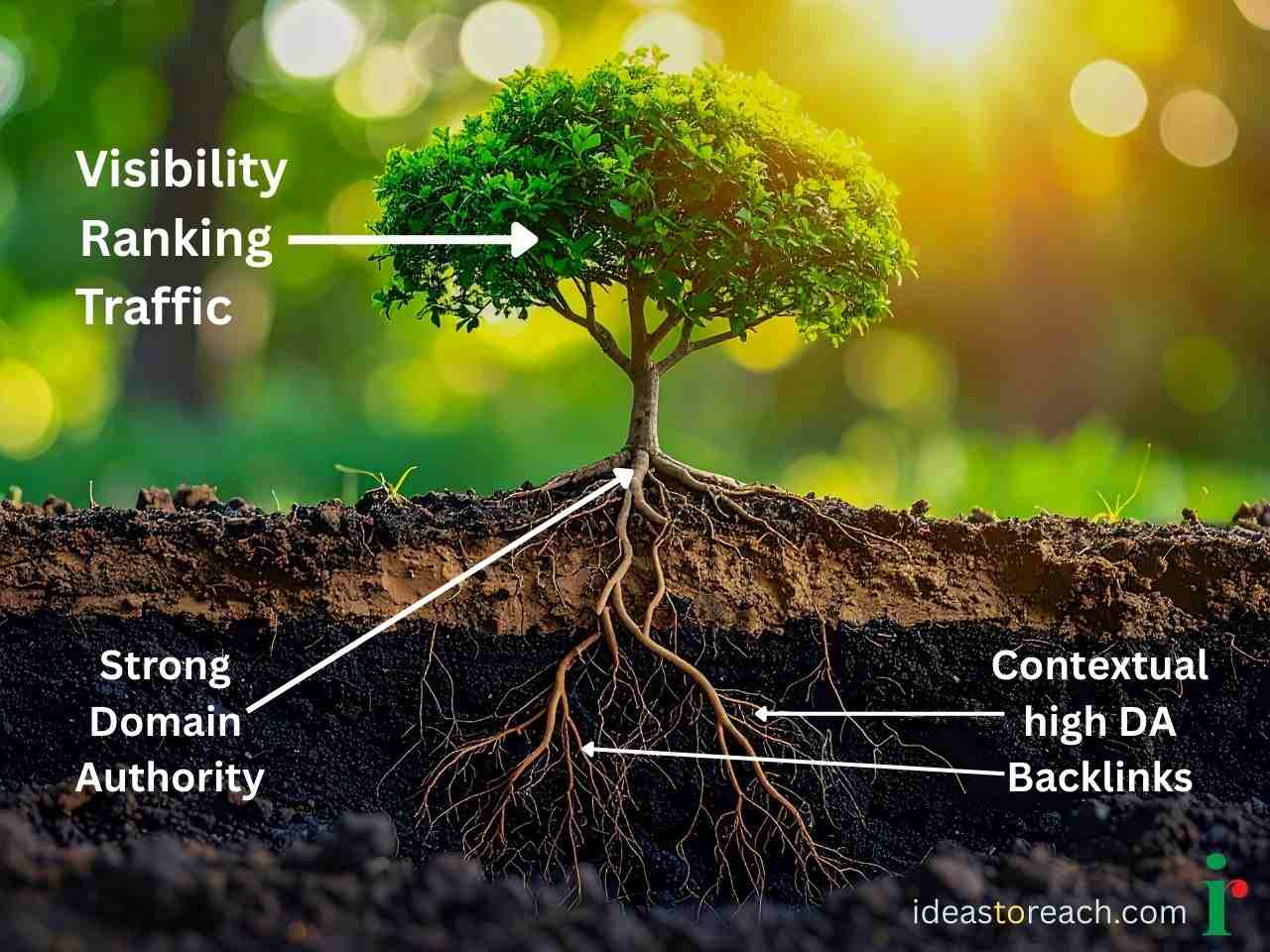
In simple terms, Domain Authority reflects how established and credible a website appears across the web, based largely on who links to it and how consistently it shows up as a trusted source.
It reflects how credible your website appears based on signals such as:
the quality and relevance of websites linking to you
mentions across trusted platforms
consistency and depth of content
overall stability of the domain
Domain Authority does not replace SEO.
It supports SEO.
When authority is improving alongside SEO work:
ranking improvements face less resistance
new pages find it easier to gain visibility
progress holds better through fluctuations
future SEO efforts compound more effectively
This is why Domain Authority should not be treated as something that comes later. It works best when strengthened in parallel, while rankings and traffic remain the primary goals.
If you want to understand this idea deeper, you can read more about how Domain Authority works as a digital reputation score here.
Imagine two businesses publishing similar content.
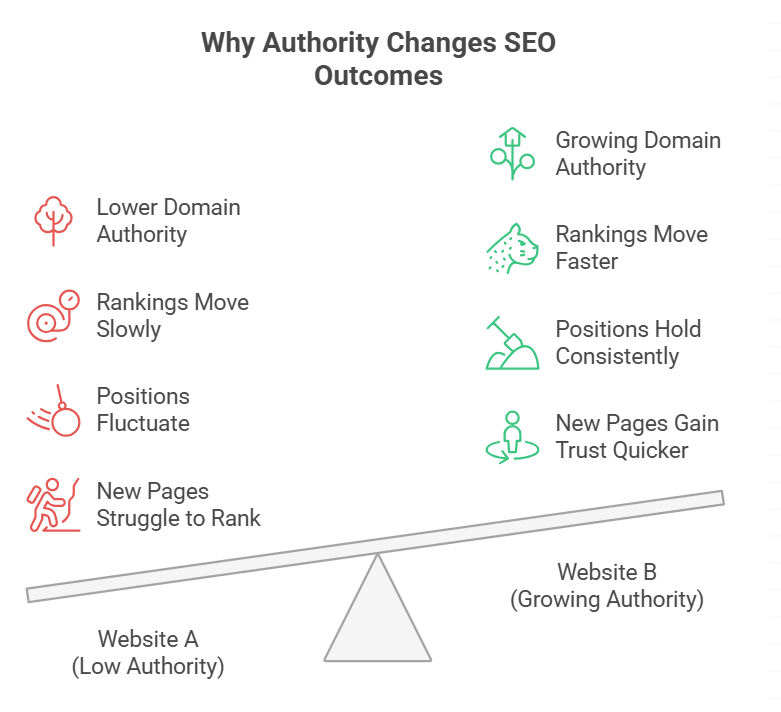
Illustration showing how the same content produces different SEO outcomes based on website authority.
The difference is not effort or content quality.
It’s trust.
Search systems are more willing to support websites that demonstrate consistent authority signals.
Instead of thinking of SEO as a single track, it helps to think of it as two parallel efforts.
The visible objective of SEO should always be clear:
Work towards better rankings that lead to meaningful traffic.
This is where SEO services focused on rankings and traffic growth deliver the most value:
content creation
on-page optimisation
technical stability
search intent alignment
This is the front-facing part of SEO and the main driver of growth.
Alongside this, there is supporting work that happens in the background.
This is where Domain Authority comes in.
Domain Authority does not change the SEO goal.
It makes that goal easier to achieve.
When Domain Authority is strengthened in parallel:
rankings face less resistance as they move up
new pages gain traction fasterprogress becomes more consistent instead of stop–start
results tend to appear quicker and hold better
In simple terms:
SEO does the pushing.
Domain Authority reduces the friction.
When SEO is done without any focus on authority:
every page has to prove itself individually
rankings often move slower
progress feels unpredictable
When authority-building runs alongside SEO:
trust is already being established at the domain level
SEO efforts compound instead of restarting
growth becomes easier to scale over time
This is why Domain Authority should not be seen as a later phase, but as a supporting system that works best when started early and runs quietly in parallel.
At Ideas to Reach, we don’t ask businesses to choose between SEO, Domain Authority, or link building.
We align them.
SEO focuses on relevance and visibility
Rankings and traffic remain the primary goals
Domain Authority and link-building work in the background to strengthen and accelerate outcomes
This approach ensures SEO doesn’t just deliver short-term movement, but builds a foundation for sustained growth.
SEO feels difficult when every page has to earn trust from scratch.
That’s when progress feels slow, results feel inconsistent, and effort feels higher than it should be.
The smarter approach is simpler.
You focus on getting found and chosen, while quietly strengthening the website behind the scenes so those efforts don’t have to work as hard every time.
When the website itself starts carrying weight, SEO stops feeling like a push.
It starts feeling like momentum.
That’s the difference between doing SEO and building something that compounds.
Good SEO helps you move forward. Strong authority makes sure you don’t keep starting over.



Please send a WhatsApp message only. Kindly do not call :
+ 91 - 99 4040 1010 | + 91 - 94 97 40 1010
Email: [email protected]