
The SEO landscape is undergoing a major transformation as Google transitions to an AI-first ranking blueprint. This shift is fundamentally changing how websites should be optimized to rank well in search results. With advancements like the Google Search Generative Experience (SGE), BERT, MUM, and RankBrain, Google’s AI-powered algorithms now prioritize user intent, content relevance, and contextual understanding over traditional keyword-based SEO tactics. As a result, businesses must rethink their SEO strategies to align with these new AI-driven ranking factors.
At Ideas To Reach, we stay at the forefront of these developments to help Indian businesses and digital marketers navigate this evolving SEO environment. Our focus is on implementing effective AI SEO strategies in India that embrace Google's new framework, ensuring websites build topical authority, meet EEAT standards, and deliver genuine information gain. This blog will dive deep into how Google’s AI search algorithm is reshaping SEO trends in India and offer practical guidance for succeeding in this AI-first era.
Google's latest algorithmic updates are powered by sophisticated AI models like BERT, MUM, and RankBrain, designed to enhance semantic search and contextual relevance. The Google Search Generative Experience (SGE) and Google AI Mode exemplify this shift, emphasizing content that satisfies user intent through comprehensive topical authority rather than simple keyword matching.
The traditional focus on backlinks and keyword stuffing no longer holds the same weight. Instead, Google's AI ranking system evaluates content using EEAT signals (Expertise, Experience, Authoritativeness, and Trustworthiness). Content must offer genuine information gain and satisfy queries through entity-based search and contextual relevance, leveraging elements such as the Knowledge Graph and Neural Matching to connect concepts intelligently.
In India, search behavior is uniquely diverse with multiple regional languages, high mobile usage, and rapid AI adoption. This evolution accelerates the need for a tailored AI SEO strategy for Indian websites that considers:
Mobile-first indexing India is critical due to widespread smartphone usage.
Voice search India requires optimized conversational and question-based content.
Local SEO India demands focus on regional language search and intent-driven local queries.
Indian SMEs & startups must build topical authority and content architecture that speaks to their niche markets.
To stay competitive, Indian websites must design their content around search intent modelling and semantic search techniques. This means structuring websites with clear hierarchies, entity SEO, and rich, informative content that Google’s Helpful Content System will recognize as valuable.
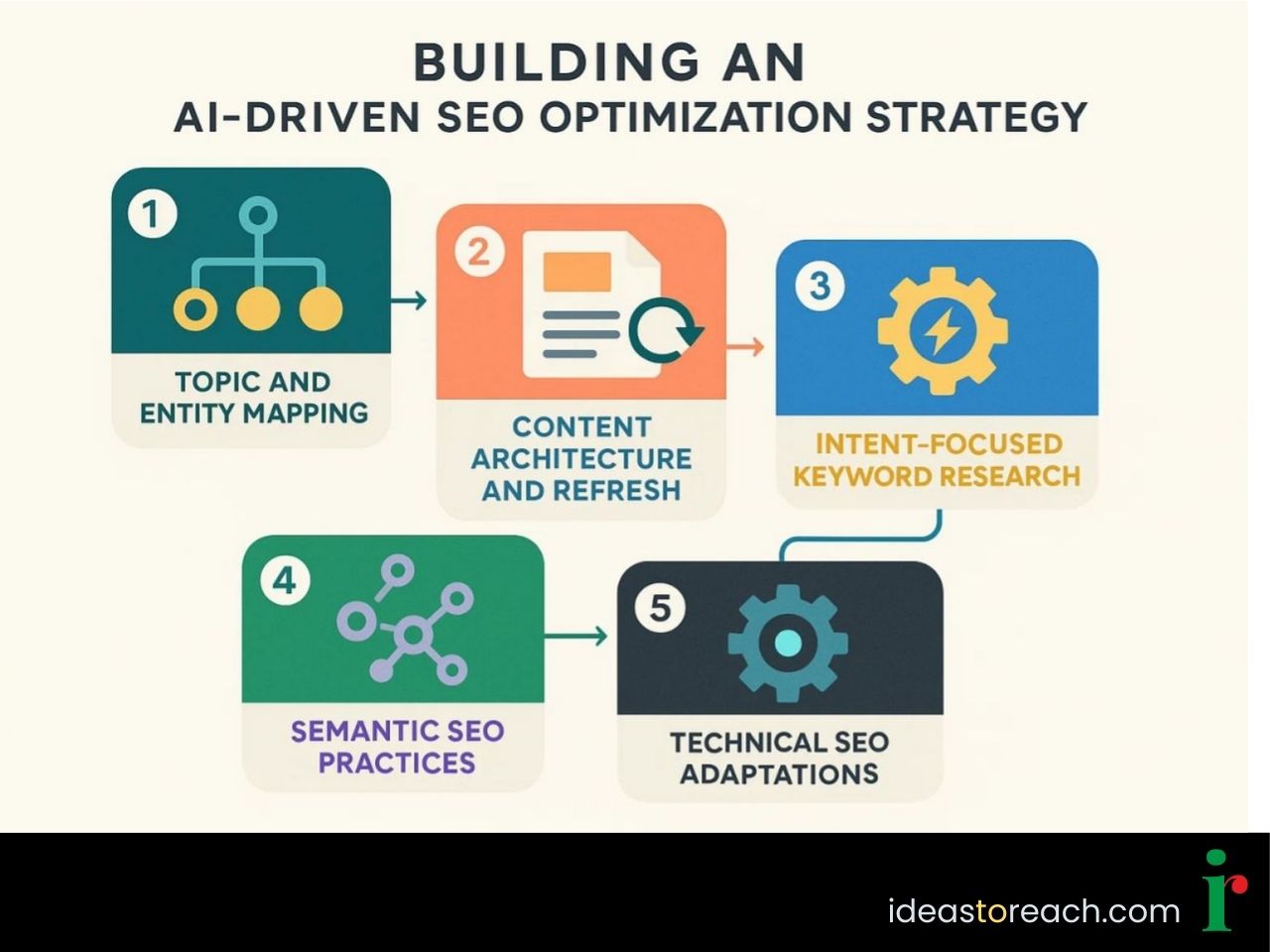
Implementing an AI-first SEO framework involves several key steps:
Topic and Entity Mapping: Develop content pillars based on core topics supported by semantically related entities. Use topical authority to signal comprehensive expertise to Google.
Content Architecture and Refresh: Organize articles and pages to boost internal linking and user experience. Regular content refreshes keep information relevant, aligning with Google’s EEAT priorities. For strategies on this, you can explore our blog on content refresh SEO.
Intent-Focused Keyword Research: Go beyond primary keywords. Incorporate long-tail keywords such as "how to optimise content for Google AI Mode" and "AI SEO strategy for Indian websites" that mirror user questions and local search habits. Our guide on long-tail keywords for SEO provides excellent insights here.
Semantic SEO Practices: Write with natural language, leveraging semantic keywords around AI concepts like Neural Matching and the Knowledge Graph to enhance contextual relevance.
Technical SEO Adaptations: Prioritize mobile-first design, fast page load speeds, and structured data to help AI-based ranking systems interpret your site better. Stay up to date with the latest in technical SEO, such as the Google Lighthouse 13 update.
Google's AI search algorithm processes queries with neural networks that understand context and user intent more deeply. This has shifted SEO towards information satisfaction and query fulfillment rather than purely keyword presence. Indian businesses can no longer rely on traditional SEO tactics but must adopt AI-based Google ranking system principles that reward genuine, expert content designed for meaningful user engagement.
The rise of AI also intersects with evolving SEO trends in India:
Increased importance of voice-activated queries and conversational search.
Greater use of entity-based search and semantic relationships.
Enhanced value of EEAT signals, especially for niche industries and local businesses.
Websites that dynamically adapt to these trends will enjoy improved visibility and higher Google rankings. For a deeper dive, visit our blog on SEO strategy for AI search.
AI is revolutionizing SEO strategy in India by moving beyond traditional keyword matching to focus on deeper user intent and topical authority. Google's AI systems now analyze how well content addresses specific queries by evaluating its structure, relevance, and overall trustworthiness. This means the quality and context of information matter more than simply repeating keywords or acquiring backlinks. Indian websites must adapt by creating content that provides real user value and aligns with how AI interprets and ranks topics.
Additionally, AI encourages the use of entity-driven content that connects related concepts meaningfully. This approach helps Indian businesses improve their rankings consistently by addressing localized search behavior, diverse regional languages, and evolving user expectations shaped by AI-powered Google features.
We recommend Indian businesses focus on holistic content strategies that integrate:
Building topical authority through in-depth content covering various subtopics.
Optimizing for regional language search and local intent using precise entity SEO methods.
Embracing mobile-first indexing India as a critical ranking factor.
Leveraging voice search India capabilities to capture emerging user behaviors.
Local SMEs and startups should also consider experience-oriented content backed by authoritative references to build trust with both users and Google’s AI algorithms.
Google's AI-driven ranking systems do not inherently penalize AI-generated content. However, quality remains king. Content must be accurate, original, useful, and aligned with EEAT principles to rank well. Poorly structured or repetitive AI content suffers in rankings, so cautious and smart use of AI tools for content creation is essential. Learn more about risks and best practices in our article on AI poisoning in SEO.
Optimizing content for Google AI Mode involves more than keywords as it's about context, relevance, and clarity:
Use search intent modelling to target user needs accurately.
Implement content architecture that supports easy navigation and coherent topical focus.
Include semantically rich terms and entities like BERT & MUM to ensure your content resonates with the AI’s understanding.
Focus on information gain and providing new, valuable insights rather than just rehashing existing content.
Following this approach improves your content's ability to satisfy Google's AI system and enhances your rankings in the AI era.
At Ideas To Reach, we proudly stand as a trusted Google Partner in Chennai, fully aligned with Google's vision to deliver cutting-edge, AI-driven SEO solutions. Our team combines deep expertise and practical experience to help Indian businesses decode the complex Google AI ranking factors that define success in this new era. We work closely with clients to develop tailored AI SEO strategies that drive sustainable, long-term organic growth while meeting the evolving demands of Google’s AI-first framework.
To support your SEO journey, we offer in-depth resources on vital topics such as the SEO flywheel vs funnel and how to test if your content is busted or performing well. These insights empower you to optimize your campaigns effectively and stay ahead in the rapidly changing AI SEO landscape. Partner with us to unlock the full potential of AI SEO strategy in India.
An AI-first SEO strategy optimizes content for how Google’s AI understands topics, entities, and relationships. Instead of focusing only on keywords, it prioritizes content structure, semantic depth, EEAT, and user intent, making it essential for ranking in AI-powered search results.
Traditional SEO alone is no longer sufficient. While technical SEO and on-page optimization still matter, Google’s AI-first ranking system evaluates content quality, context, and usefulness more deeply. SEO strategies must evolve to include topical mapping, semantic relevance, and trust-building signals.
Indian businesses should focus on building topical authority, improving content structure, targeting intent-based queries, and addressing local and regional search behaviour. Optimising for mobile, voice search, and AI-powered Google features is now critical for long-term SEO success in India.
Yes, AI-generated content can rank in Google Search if it is helpful, original, accurate, and demonstrates EEAT. Google’s AI systems do not penalise AI content itself, but low-quality, unstructured, or repetitive AI-generated pages are unlikely to perform well.



Please send a WhatsApp message only. Kindly do not call :
+ 91 - 99 4040 1010 | + 91 - 94 97 40 1010
Email: [email protected]